When AI Companies Hire, Trade Secrets Walk Out the Door
Apple just sued OpenAI over trade secret theft tied to former employees. Here is what that lawsuit actually signals for any operator thinking about AI, talent, and confidential information.
The Signal #044 — Dakota’s read on the AI news that actually matters to people running a business.
The AI talent war just produced its first major corporate lawsuit. And the details are specific enough that any operator running a team should read them carefully.
This is not an abstract legal dispute between two tech giants. The conduct described in Apple’s complaint maps to real operational risks that show up anywhere people change jobs, take files home, or interview at competitors while still on your payroll.
What happened
On July 10, 2026, Apple filed a lawsuit in the U.S. District Court for the Northern District of California against OpenAI, naming former Apple employees Chang Liu and Tang Tan as defendants, along with OpenAI and io Products. The full story is here.
Tang Tan served as VP of product design at Apple, leading iPhone and Apple Watch product design. He departed Apple in February 2024 to work with Jony Ive. Chang Liu worked at Apple for eight years as a senior system electrical engineer before joining OpenAI in January 2026.
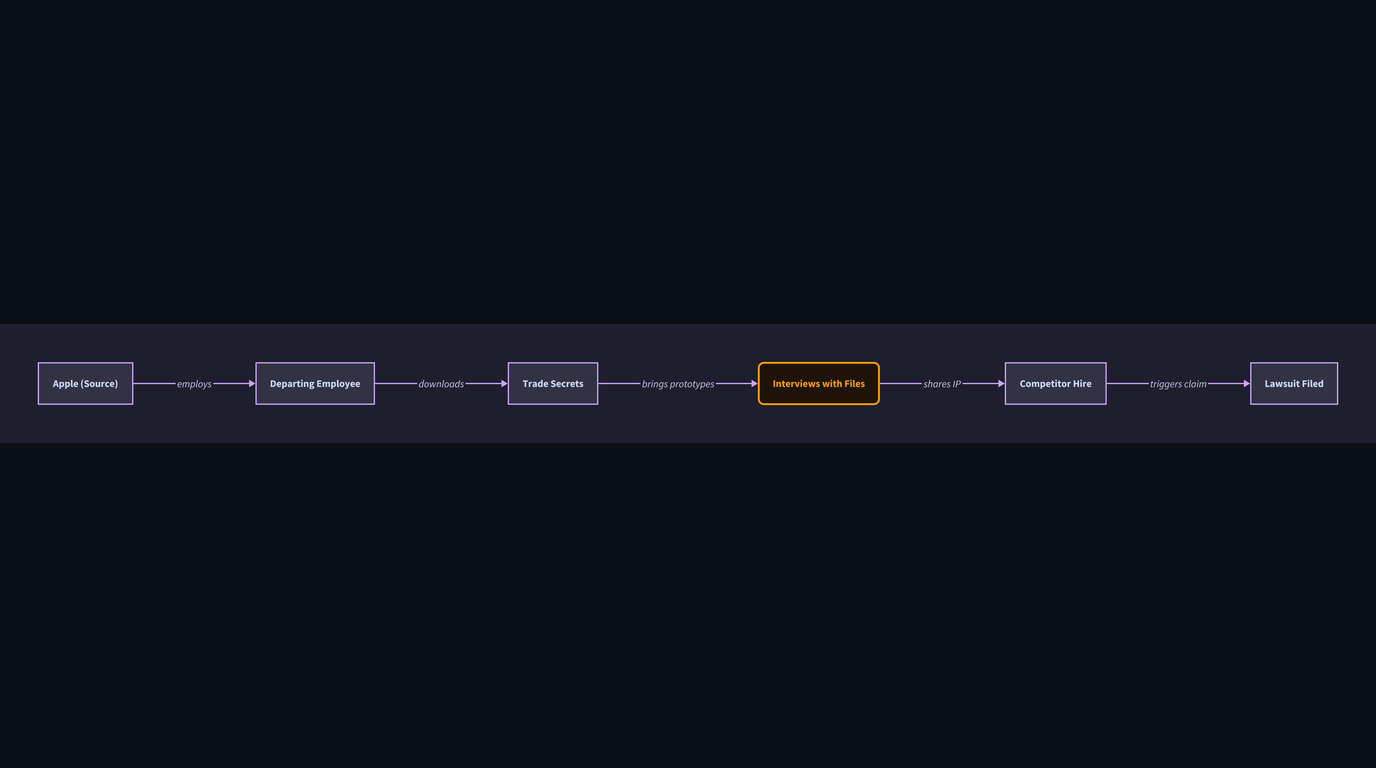
The allegations are worth reading closely. According to the complaint, Tan used an internal Apple project codename during job interviews to ask candidates what the plan was for an unannounced product. He directed candidates still employed by Apple to bring “actual parts” from Apple offices to interviews for what the complaint calls “show and tell” sessions. OpenAI was allegedly instructing candidates to bring “CAD/design artifacts” and “prototypes,” and to share details about subsystem design, component selection, and vendor relationships.
At least one candidate, the filing says, commented that he “didn’t even know we could take those from the office.”
The complaint also says a candidate began screenshotting and downloading files relating to a confidential Apple project hours before an interview with Tan, who then “solicited more information about that same Apple project” during the interview. Apple calls this an “established pattern.”
On the Liu side, Apple alleges he exploited a security bug to download confidential engineering files after leaving the company, including a “compilation of technical files with over a thousand pages” of detailed manufacturing documents. Rather than report the exploit, Liu allegedly joked about it in messages. He also allegedly failed to return an Apple-issued laptop after his departure, and coached another Apple employee he was recruiting to OpenAI on which confidential materials to study beforehand.
Apple says it raised concerns directly with OpenAI in February, asking the company to investigate. OpenAI never responded. Apple’s statement to press described this as “the tip of the iceberg.”
Why it matters for operators
Most operators read a story like this and think: that is a Big Tech problem. It is not.
The behaviors described here, candidates carrying files to interviews, employees downloading materials before a departure, departing staff failing to return equipment, insiders coaching recruits on what to take, these are not unique to hardware companies or billion-dollar AI labs. They happen at accounting firms, logistics companies, SaaS startups, and medical practices. The scale is different. The pattern is not.
What makes this moment different is that AI has raised the value of specialized internal knowledge dramatically. A manufacturing process document, a vendor relationship map, a product roadmap, an internal workflow built around proprietary data. These things have always had value. But right now, companies building AI products are specifically hunting for operational and technical context they cannot get from public sources. That changes the incentive structure around your people.
If you are running any kind of operation with proprietary processes, undisclosed product plans, vendor contracts, or internal tooling that gives you an edge, the question this case raises is simple. Do you actually know what walks out the door when someone leaves?
What most people get wrong
Most operators treat offboarding as an HR checklist. Return the badge, close the accounts, send the severance paperwork. Done.
The Apple complaint describes something more systematic. It describes a departing VP distributing an internal Apple “Need to Know” document covering departure security protocols to new OpenAI hires before those hires had even given their notice to Apple. People were being prepped on how to leave before anyone knew they were leaving.
That is an offboarding failure that starts long before offboarding begins.
The other thing operators get wrong is assuming intent is the threshold. The candidate who said he “didn’t even know we could take those from the office” was not necessarily malicious. He was just responding to a request from someone in a position of authority during a job interview. Ambiguity is the gap that these situations exploit. If your people do not have a clear, internalized sense of what is confidential and what is not, the line is invisible until someone crosses it.
The closing lesson
The AI hiring boom is not slowing down. Companies are aggressively recruiting people who have worked inside competitors, not just for their skills but for their context. That context includes your processes, your vendor relationships, your roadmap, and your internal tooling.
You do not need to be Apple to have something worth protecting. You need to be running anything that works, because something that works is exactly what someone else wants to understand.
Review what your people have access to. Review what happens when they leave. Make the line visible before someone crosses it by accident, or on purpose.
If you want help thinking through what AI governance and operational risk actually look like for a team your size, start at xovionlabs.com.