The Compute Is Coming Home
NVIDIA wants to bolt a half-million-dollar AI data center onto the side of your house. I'm building the same thing in my backyard — except I'll own all of it. The case for local AI, privacy, and why ownership beats hosting.
I’ve been going down a rabbit hole lately, and I want to share where my head’s at.
It started with where I live. I’ve got a 1.25-acre lot north of Scottsdale — no HOA, almost no limits, so I can basically build whatever I want out here. And it’s 115 degrees six months out of the year while I’m sitting 20 minutes from the city. At some point I just looked around and thought: why wouldn’t I power this whole place with solar?
Once I started pulling on that thread, I couldn’t stop. Why couldn’t I put in a ground-mount array? Why couldn’t I run the entire house off it? Why couldn’t I run my own AI compute right here while I’m at it? Every “why couldn’t I” had a surprisingly good answer, so a couple months ago I sat down and built out the whole plan — solar farm, batteries, compute, all of it. And I’m still 100% doing it.
Then, a few weeks ago, NVIDIA announced almost the exact same concept.
NVIDIA Wants to Put a Data Center on Your House
They’ve teamed up with a startup called Span and the homebuilder PulteGroup to bolt little AI data centers — they’re calling them XFRA nodes — onto people’s homes. The boxes are about the size of an AC condenser. They tap the unused electrical capacity your house isn’t using, run GPUs for AI workloads, and the homeowner gets free or discounted power for hosting one. The first pilots are rolling out in the southwest, basically Nevada or Arizona.
Here’s the part that gets me, though. They roll up and install what’s essentially a half-million-dollar piece of equipment on the side of your house, shave a little off your power bill, and act like they’re cutting you a check — but you don’t own any of it. It’s their box, their GPUs, their network, their money. You’re renting out a closet and calling it a win.
My version is the opposite. I build it. I power it with my own solar. And I own the whole thing, top to bottom — the panels, the batteries, the hardware, all of it. Same idea. But it’s actually mine.
I’m not going to act like I’m smarter than anybody, because I’m really not — it might just be luck. But it is a little funny when something you sketched out at your kitchen table shows up as a national rollout from the biggest chip company on earth a few weeks later. Makes me feel like maybe I’m a step ahead on this one.
Why I Think Local AI Is the Future
The deeper reason this stuck with me is that I’m convinced this is where everything’s headed: local AI is the future.
Most people don’t realize there are two worlds of AI right now. There’s the cloud stuff — ChatGPT, Claude, Gemini — running in massive data centers owned by trillion-dollar companies. And there are “open-weight” models, like Meta’s Llama and Google’s Gemma, that you can download and run on your own hardware, in your own house.
The open models trail the big cloud ones by maybe 6 to 12 months. That sounds like a lot, but it isn’t — because “good enough” is a moving target, and the gap that actually matters is shrinking fast. For the vast majority of real work — coding, writing, organizing data, answering questions — a model running on a home server is already more than enough.
So why run it yourself? Three reasons I keep coming back to:
Privacy. With a cloud model, your data leaves your house — business records, client info, personal notes, all sent off to someone else’s server. With a local model, nothing ever leaves the building. That’s a big deal when you run businesses and handle sensitive data every day.
Control. Cloud models change overnight. Guardrails shift, features get pulled, a task that worked yesterday suddenly gets refused. When you own the model, you own the rules. Nobody can change them on you.
Cost and speed. API calls add up fast. Own the hardware and your main ongoing cost is the electricity bill — which, in my case, the sun is covering. No round trip to a server, either. It runs right there.
The cloud isn’t going away. The bleeding edge — the models discovering new drugs, solving frontier math, doing heavy multimodal work — will live in the big data centers for a long time, because that stuff needs the horsepower. But not everyone needs a Formula 1 car to drive to the grocery store. Most of us just need a reliable daily driver. For 95% of what I do, a local model is the daily driver.
That’s why I’m building. Even if I never rent out a minute of it, learning how to deploy, host, and fine-tune this stuff myself might be one of the most future-proof skills I can pick up right now. The people who understand how to own and run this — not just rent it — are going to have a real edge.
By the Way — Here’s What I’m Actually Talking About
To be clear, the whole point of this is to power my own house and run my own AI compute off the sun. That’s the actual goal. But once you build something like this, your brain naturally wanders to huh… could I rent the extra out? I’m not even sure I want to. But if I did, here’s how it’d actually work — built backwards from the money, in five steps:
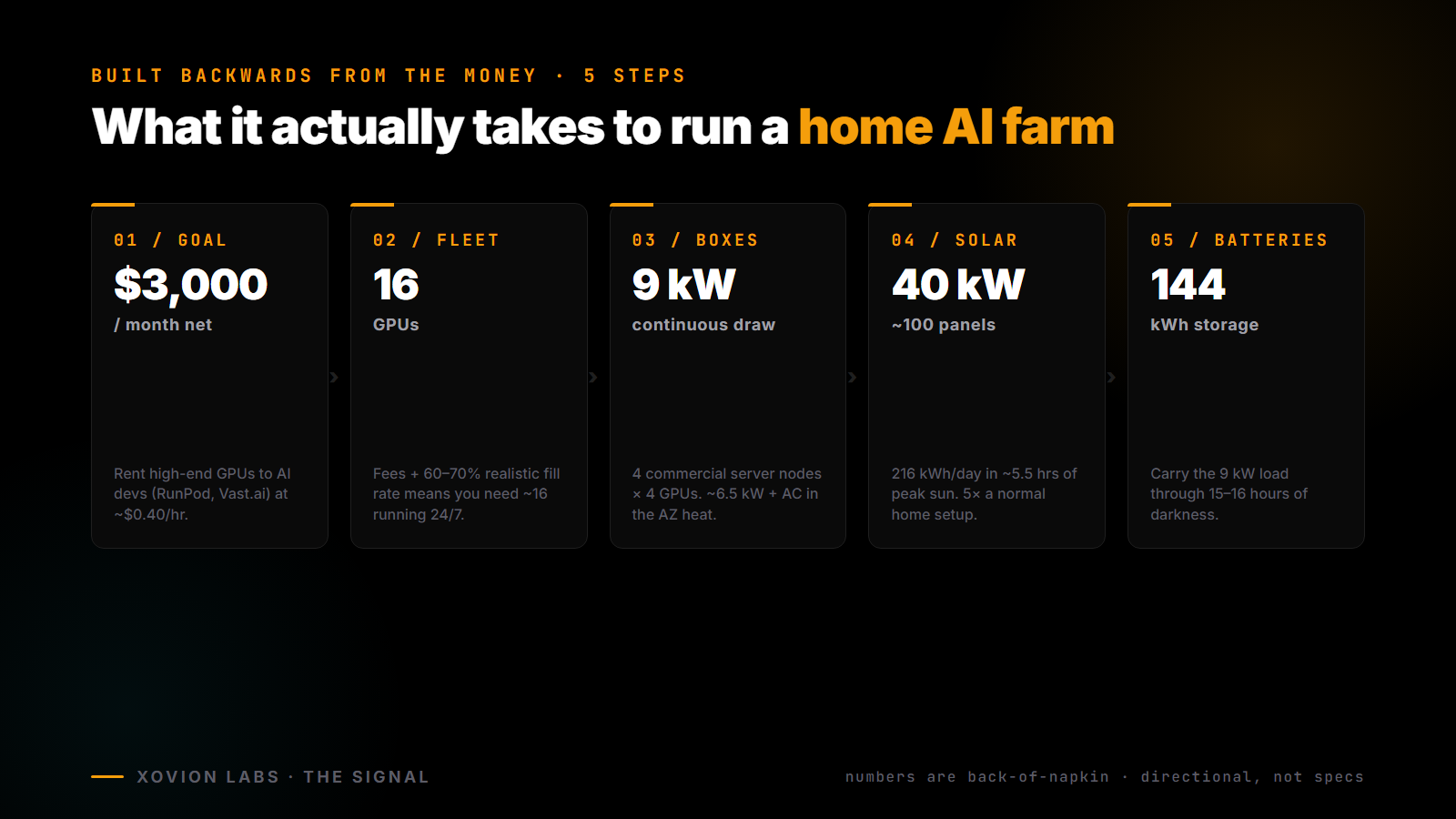
1. Start with the goal. Say I want it to clear $3,000 a month. You can rent a high-end GPU to AI developers on platforms like RunPod or Vast.ai for around $0.40 an hour.
2. Size the fleet. After platform fees and the reality that nothing runs at 100% (a realistic fill rate is 60–70%), that lands at about 16 GPUs running around the clock to actually net $3K.
3. Build the boxes. You don’t build 16 gaming PCs — you build four commercial server nodes, four GPUs each. They pull about 6.5 kW on their own, and once you add the heavy AC to keep them from cooking inside a steel container in the Arizona summer, you’re at roughly 9 kW of continuous draw, day and night.
4. Build the solar. 9 kW around the clock is 216 kWh a day. To generate that during the ~5.5 hours of real peak sun out here, you need about a 40 kW array — roughly 100 standard panels, five times a typical home setup.
5. Build the battery wall. The servers can’t just shut off when the sun goes down (kill your uptime, kill your host rating), so you need enough storage to carry that 9 kW load through 15–16 hours of darkness — about 144 kWh.
So if I ever flipped the switch on renting it out, the simple version is this: buy specialized computers, rent them by the hour to AI developers over the internet, and let the 100-panel solar plant and battery wall keep them — and their air conditioning — alive through the night. I might never do it. But it’s wild that the option is just… sitting there once the infrastructure exists.
The Compute Is Coming Home
So whether it’s NVIDIA strapping boxes to PulteGroup houses or me building a solar-powered rig out in the desert, it’s the same direction. The compute is coming home. I just want to own mine. 🌵
Anyone else running local models at home yet? Curious what hardware you landed on.