OpenAI Built a Chip. Here Is What That Means for What You Pay.
OpenAI just unveiled its first custom inference chip, named Jalapeño, built with Broadcom. Here is what that hardware move actually signals for operators who depend on AI in their daily work.
The Signal #039 — Dakota’s read on the AI news that actually matters to people running a business.
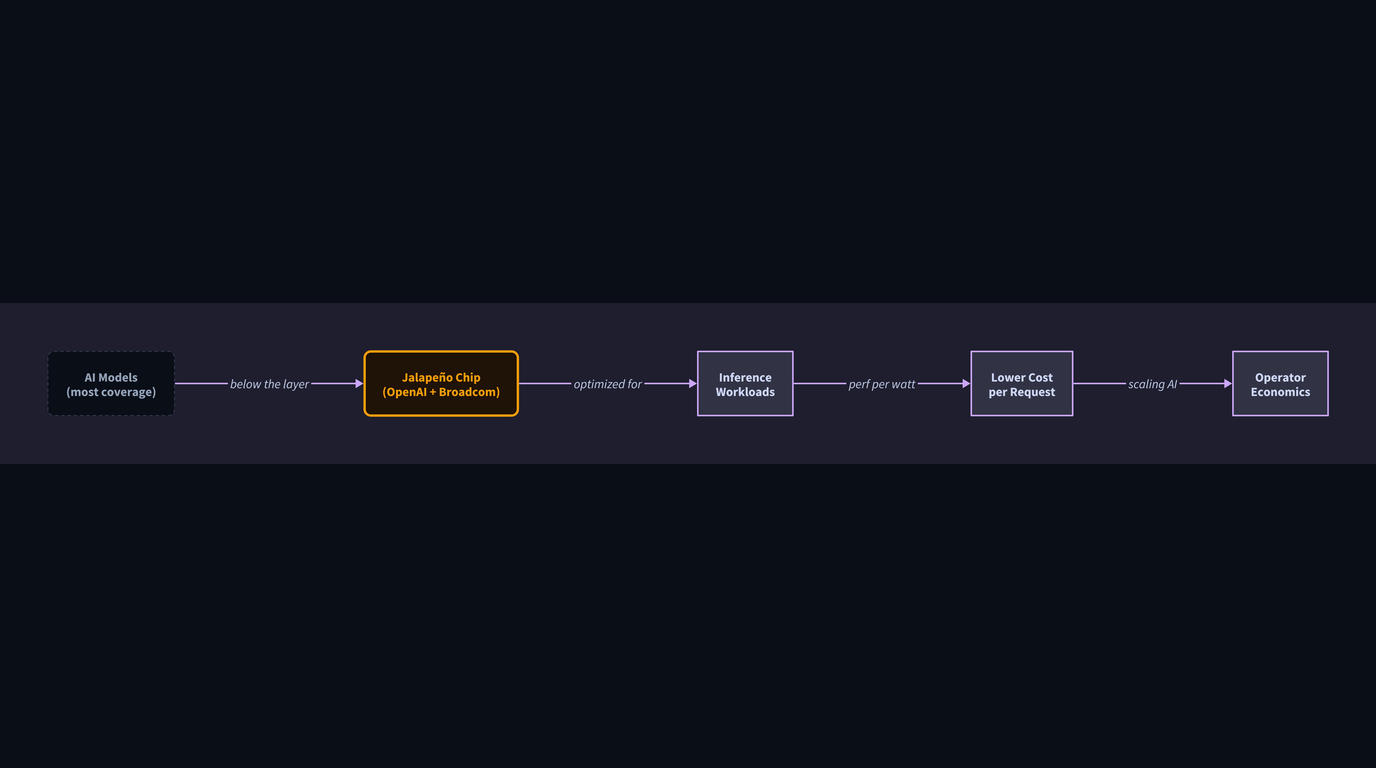
Most AI news is about models. New capabilities, higher scores on benchmarks, bigger context windows. The chip news that dropped this week is different. It sits one layer below all of that, and it touches something operators actually care about: cost.
What happened
On June 24, 2026, OpenAI unveiled its first custom-built inference processor, designed and manufactured in collaboration with Broadcom. The chip is called Jalapeño. It was built specifically for inference, which is the process of running a pre-built AI model in response to a user request. That is the part of AI that happens every time someone sends a message, generates an output, or triggers an automated workflow.
OpenAI says early results show significantly better performance-per-watt than current state-of-the-art alternatives, though the chip is still being tested. OpenAI also noted that its own AI models assisted in developing the chip. In the announcement, the company specifically highlighted Jalapeño’s low operating cost when running real-time coding models.
The broader context: OpenAI has long relied on Nvidia GPUs. Google and Amazon have both built their own custom chips, often called AI accelerators (silicon designed specifically to speed up machine learning workloads), for the same reason. This is OpenAI joining that same strategic move.
Greg Brockman, OpenAI’s president, explained the thinking in a podcast episode after the Broadcom partnership was announced in October. “We have a deep understanding of the workload,” he said. “We’ve really been looking for specific workloads that are underserved, how can we build something that will be able to accelerate what’s possible?”
OpenAI put it plainly in the announcement itself: “OpenAI is not only developing frontier models or building products on top of them; it is designing the infrastructure underneath them: chip architecture, kernels, memory systems, networking, scheduling, deployment systems, and product experience.”
Why it matters for operators
Here is the part most coverage skips.
Every time you or someone on your team sends a prompt, runs an automated task, or uses an AI-powered tool inside your operation, that request has to be processed somewhere. That processing costs money. Right now, a significant chunk of that cost flows through Nvidia hardware, and OpenAI pays for it. Those costs shape what OpenAI charges developers and, by extension, what the businesses using those tools pay.
Inference cost is one of the real friction points for scaling AI inside an operation. A professional services firm running AI-assisted document review on a few projects a week hits a very different bill than one running it across hundreds of matters a month. A SaaS product that uses AI for one feature pays very differently than one where AI is embedded across the entire user experience. The economics of going deeper with AI are directly tied to what inference costs.
When OpenAI reduces its cost to run models, the downstream effect, even if it takes time to pass through, is that AI-powered work gets cheaper to do at scale. That changes the math on where it makes sense to introduce AI inside an operation and how far you can take it without blowing up a budget.
What most people get wrong
The easy read on this story is that it is a Nvidia story. OpenAI is reducing dependence on one vendor, diversifying its supply chain, normal corporate strategy. That framing is not wrong, but it misses the more useful signal.
The real story is vertical integration. OpenAI said it directly: each layer of their stack, from chip to model to product, is now being optimized around the same goal. Faster, more reliable, more affordable. That is not a story about one company’s supplier relationship. It is a story about what happens when the people building the models also control the hardware those models run on.
Google has been doing this with TPUs (their custom AI chips) for years. Amazon has Trainium and Inferentia. What you are watching is the AI industry mature into something that looks more like traditional tech infrastructure, where the companies with the most usage have the most incentive to build their own silicon, and the companies that do it well pass cost and performance advantages down to whoever builds on top of them.
For an operator, the wrong move is to read this as deep technical news that does not concern you. The right move is to understand that the cost curve for AI inference is going to keep moving, and the direction it is moving is down.
The takeaway
Jalapeño is not a product you will ever buy or touch directly. But the fact that it exists tells you something useful about where AI pricing and capability are heading. The infrastructure underneath the tools your business uses is getting more purpose-built, more efficient, and more competitive. That compounds over time.
The operators who will get the most out of that shift are the ones already figuring out where inference-heavy AI tasks live in their operation, and building the workflows around them now, before the economics become obvious to everyone else.
If you are working through where AI actually fits in your operation, xovionlabs.com is a good place to start.