60% of Consumers Find 'AI' in Brand Messaging a Turnoff. Here's What Operators Should Do With That.
New research from WordPress VIP finds that 60% of consumers say AI in a brand's messaging is a turnoff, and 61% can't name a single brand using it well. Here's what that actually means for operators making content and messaging decisions right now.
The Signal #028 — Dakota’s read on the AI news that actually matters to people running a business.
Most brands spent the last two years racing to put AI front and center. In the product copy. In the sales deck. In the email subject line. The research says the audience noticed, and not in the way anyone hoped.
What happened
WordPress VIP published a consumer research report called Future of the Web 2026 that asked consumers how they feel about AI across brand messaging and the web broadly. The numbers are worth sitting with.
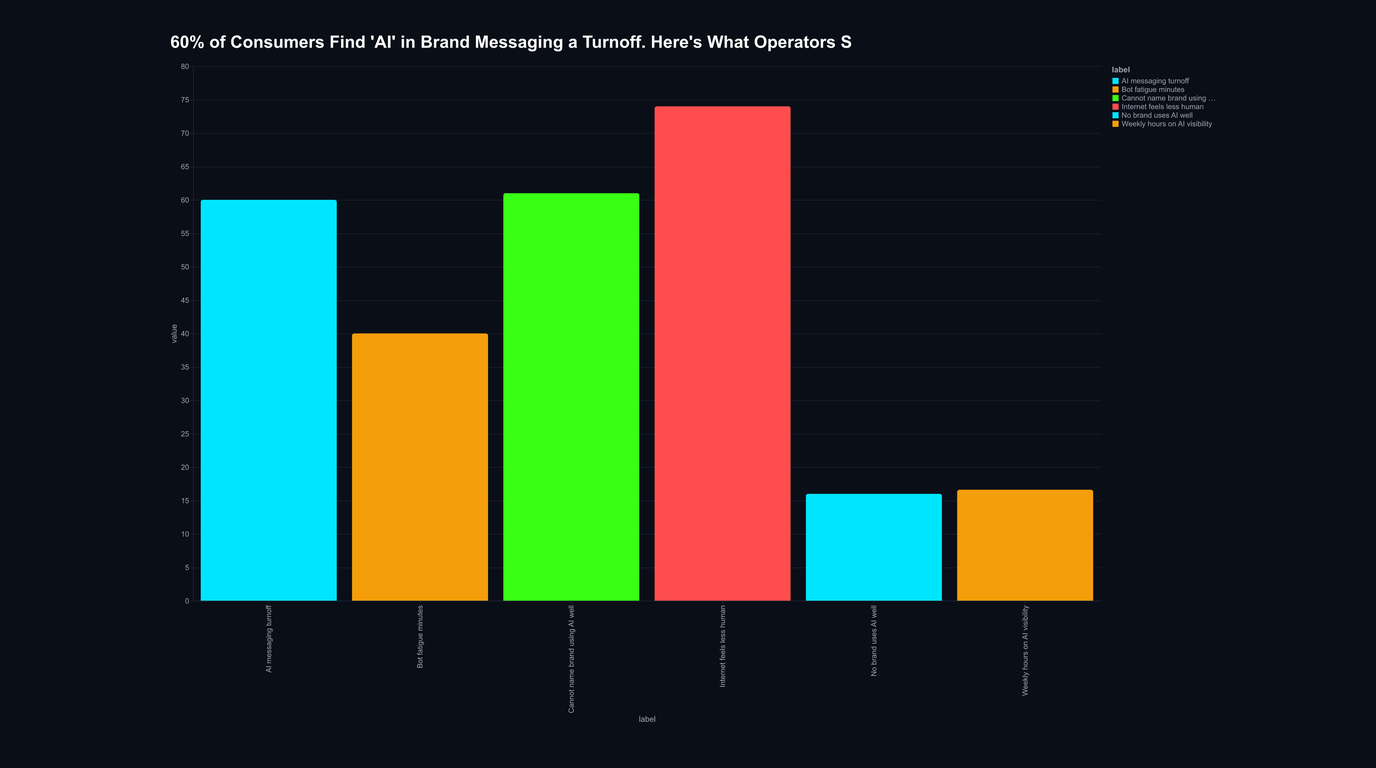
Sixty percent of consumers say AI in a brand’s messaging is a turnoff, not a feature. Sixty-one percent can’t name a single brand they think is using AI well in its messaging. Sixteen percent went further and said no brand is using AI well at all. Seventy-four percent of consumers say the internet feels less human than it did ten years ago. And the average time before someone hits what the report calls “bot fatigue” (the point where interactions start to feel synthetic and people check out) is 40 minutes.
That last number is the one to bookmark. Forty minutes is not a long runway. It means a consumer can land on your site, work through your chatbot, read your AI-assisted FAQ, and be fully done with you before the first hour is up, not because your product failed, but because the experience stopped feeling honest.
Brian Solis, Head of Global Innovation at ServiceNow, is quoted in the report saying: “No customer or user wakes up and says, ‘I hope I get to talk to a chat bot or an AI agent today.’ Human-centered design is truer today with artificial intelligence. Ironically, the answer is using AI to be more human.”
That quote is doing a lot of work. It’s worth reading twice.
Why it matters for operators
If you run a SaaS company, a healthcare practice, a real estate brokerage, or a professional services firm, your brand messaging is a trust signal before it is anything else. Customers are not evaluating your AI stack. They are evaluating whether you feel worth their time.
The research is showing that leading with AI as a selling point is landing backwards. Operators who built messaging around “AI-powered” features assumed the audience shared their enthusiasm for the technology. Most of them do not. What the audience is actually filtering for is whether the experience on the other end of that message feels like a person gave a reasonable amount of thought to their situation.
This also matters for content. The report notes that enterprises are spending an average of 16.6 hours per week improving AI brand visibility (how often their brand appears in answers generated by tools like ChatGPT, Perplexity, Claude, and Gemini). That is a real operational cost. And the research suggests that while chasing AI citation volume, many brands are quietly eroding the human quality of the content that made them worth citing in the first place.
The two goals are not automatically at odds. But they require conscious management, and right now most teams are optimizing for one and guessing at the other.
What most people get wrong
The instinct when you see a stat like “60% say AI is a turnoff” is to conclude that the answer is hiding the AI. Don’t mention it. Scrub it from the copy. Pretend the chatbot is a person.
That is not what the research is pointing toward, and it would be its own kind of dishonesty.
The smarter read is that consumers are reacting to AI being treated as a feature when what they actually want is a result. A real estate agency that uses AI to surface better comps faster does not need to headline that in their client emails. The client wants accurate comps quickly. Lead with the outcome. The AI is the plumbing, not the pitch.
The 61% of consumers who can’t name a brand doing this well is also a signal worth holding onto. The research frames it as a gap, and it is. But gaps have a first mover. The brands that figure out how to use AI to make their content and service feel more relevant, more responsive, and more genuinely useful to the person on the other end, without turning every touchpoint into an AI announcement, are the ones that will build the kind of trust that compounds over time.
The lesson
AI is not a message. It is a method. Operators who keep confusing the two are going to keep burning the 40-minute window the research is describing.
The content your customers read, the emails they receive, the chat interactions they have, those things are judged by one standard: did this feel worth my time. AI can absolutely help you meet that standard. Announcing that you used it usually gets in the way.
If you want to think through how AI fits into your operations without turning it into a liability in your messaging, the team at xovionlabs.com is worth a conversation.