The Signal
AI
Microsoft Just Shut Down Its Internal AI Research Group. Here Is What That Decision Reveals.
Microsoft's AI Frontiers group, a roughly 50-person research team inside Microsoft Research, was dissolved in early September after being folded into a larger organization with a fundamentally different philosophy. Here is what that internal decision tells operators about how the biggest players in AI are actually thinking right now.
The Signal #129 — Dakota’s read on the AI news that actually matters to people running a business.
One of the more honest pieces of AI writing published recently did not come from a journalist. It came from a researcher who just walked out the door.
John Langford, one of the founding leaders of Microsoft’s AI Frontiers group (a roughly 50-person sub-organization inside Microsoft Research focused on coordinated, coherent AI research efforts), published a detailed account of why the group no longer exists. It is worth reading slowly, because the reason it ended says something clear about how large institutions are currently making bets on AI, and what that means for everyone downstream.
What happened
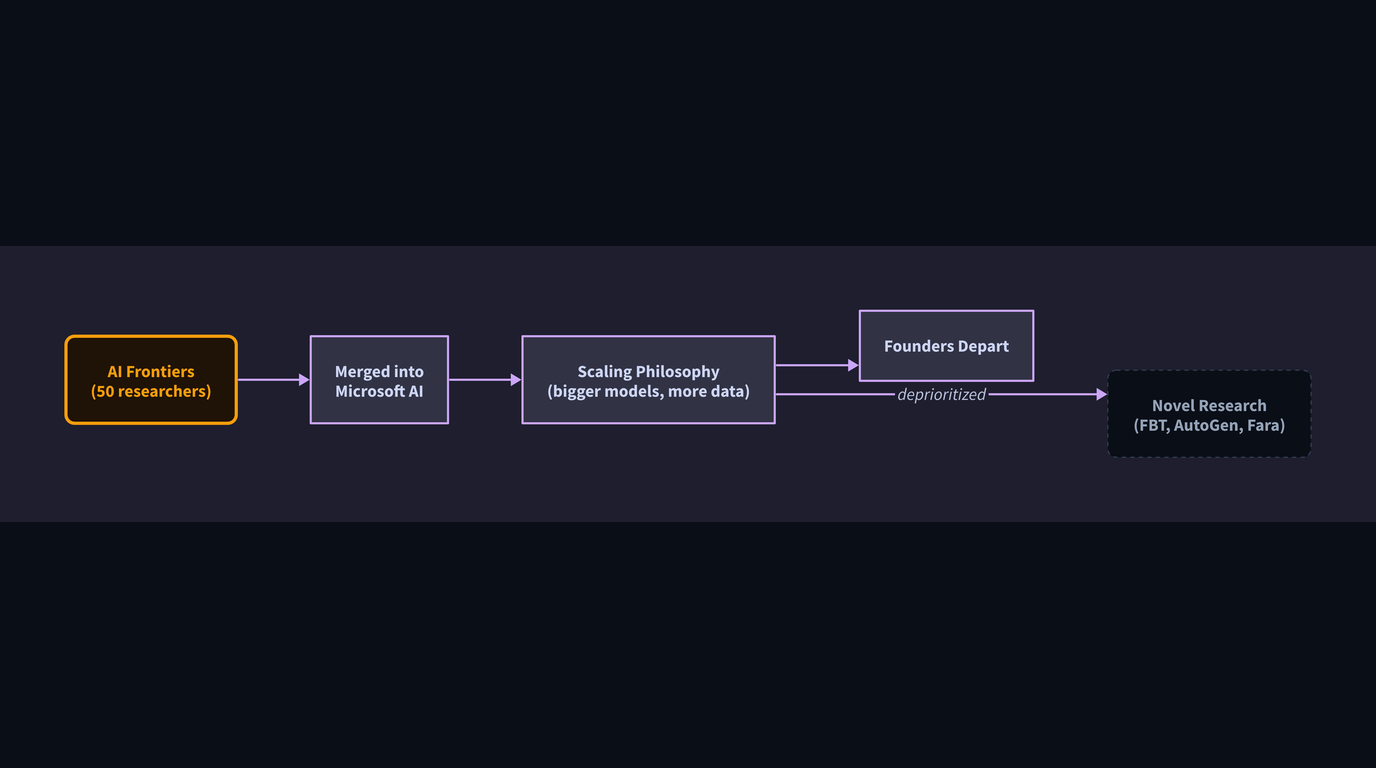
AI Frontiers was formed in 2023, shortly after the ChatGPT release, when Langford and several colleagues concluded that individual researchers working alone could not keep pace with well-organized, heavily resourced competing teams. The group grew to around 50 people and focused on what Langford describes as the “messy middle” between top-down direction and bottom-up exploration. Their work included the AutoGen orchestration framework (a system for coordinating AI agents, meaning AI components that can take actions and hand work off to each other), a computer-use agent called Fara, and a shared model-building codebase made available across all of Microsoft Research.
In early September, AI Frontiers was reorganized into Microsoft AI, the larger organization led by ex-Inflection leadership. The merger did not go well. Langford describes the core philosophy of that leadership as “scaling, and aggressively not research.” In plain terms, that means the belief that the primary path to better AI is bigger models trained on more data, not novel ideas or architectural breakthroughs. Data acquisition and refinement becomes the main job. Research, in the traditional sense, becomes secondary.
Langford and the other founding AI Frontiers leadership left. He writes that every other founding member reached a similar conclusion independently.
Why it matters
Operators do not need to follow internal Microsoft org charts to feel the downstream effects of this kind of decision.
Here is the practical tension Langford describes. Scaling (making models bigger, feeding them more data) produces predictable returns. If you spend more, you get a measurably better model. Research produces unpredictable returns, but sometimes those returns are enormous. His example is concrete. ByteDance experiments, he writes, suggest a variant of the Full Bandwidth Transformer (an architectural approach AI Frontiers was developing, which uses recursion to make models more capable without simply making them larger) might be comparable to a model of twice the size. That would mean roughly half the training and inference cost for the same capability. He frames the business implication directly: “Do the math. How much is it worth to halve training and inference cost given that the industry has investments approaching a trillion dollars?”
That question matters to any operator buying AI capacity. If the dominant labs consolidate around scaling as the only strategy, pricing and capability curves become more predictable but also more uniform. The labs that pursue architectural research, the kind AI Frontiers was doing, are the ones more likely to produce step-change reductions in cost or increases in capability that reshape what operators can afford to do.
A real estate technology company evaluating whether to build an AI-assisted underwriting workflow, or a healthcare SaaS company deciding whether to embed a document-reasoning layer, is making those decisions based on current API pricing and current model capability. Both of those numbers can shift significantly if research breakthroughs compound, or stagnate if the industry just scales the same architectures.
What most people get wrong
Most coverage of AI organizational news focuses on drama. The more useful read is structural.
Langford is not just writing about a difficult reorg. He is describing a fork in strategy that is happening across the industry, not just at Microsoft. The question of whether returns to research are real and significant enough to compete with returns to scale is one every major lab is answering right now, often quietly, through hiring freezes, team consolidations, and resource allocation decisions that never make headlines.
The operators who get hurt are the ones who assume current AI pricing and capability represent a stable baseline. They are not. They are outputs of strategic bets being made right now by organizations with very different theories of how progress happens.
Langford’s framing is clear and worth sitting with: “It is an understandable failure mode. Scaling is straightforward and it is common for people to give up on a tradeoff between multiple competing ideals by short-sightedly adopting one in totality and dropping the other.”
That sentence applies well beyond AI labs.
The takeaway
When a credible researcher publishes a detailed account of why they left a major institution, the useful question is not who is right about scaling versus research. The useful question is: what does the answer mean for the tools and costs I am planning around?
AI capability and pricing are not fixed inputs for your business. They are outputs of organizational and strategic decisions being made at labs right now. Langford’s post is one of the cleaner windows into how those decisions actually get made.
If you want to stay current on what AI developments actually mean for operators making real decisions, visit xovionlabs.com.
The Signal
Read next.
AI · AI Strategy
Claude Is Not Your Architect
A post titled 'Claude is not your architect' just hit the top of Hacker News. The lesson isn't really about code — it's about who makes the decisions in a business that runs on AI.
AI · AI Governance
Goldman Sachs Just Pulled AI Coding Tools From Its Traders and Bankers. Here Is What That Decision Actually Tells Operators.
Goldman Sachs restricted Anthropic's Claude Code and Microsoft's GitHub to engineers only, cutting off traders and bankers who had been building their own tools. Here is what the reasoning behind that call means for any operator thinking about who gets access to AI agents.