The Signal
AI
DeepSeek Just Open-Sourced Its Inference Framework. Here Is What That Actually Means.
DeepSeek released DeepInfer, an open-source inference framework built for running DeepSeek models at scale. Here is what operators need to understand about why this kind of infrastructure release matters beyond the model headline.
The Signal #114 — Dakota’s read on the AI news that actually matters to people running a business.
The AI headlines usually go to the model. The infrastructure that actually runs the model tends to get skipped.
DeepSeek just released DeepInfer, an open-source, high-performance inference framework built specifically for running DeepSeek models at scale. It is a quieter release than a new model drop, but for anyone thinking seriously about how AI runs in production, it is worth understanding what is actually in that announcement.
What happened
DeepSeek released DeepInfer as an open-source project, describing it as a high-performance, large-scale inference framework designed for DeepSeek models.
Inference, in this context, means the process of actually running a model to produce output. Training is the expensive, one-time process of building the model. Inference is everything that happens after, every time someone sends a prompt and gets a response back. Most of what operators pay for when they use AI in a product or workflow is inference.
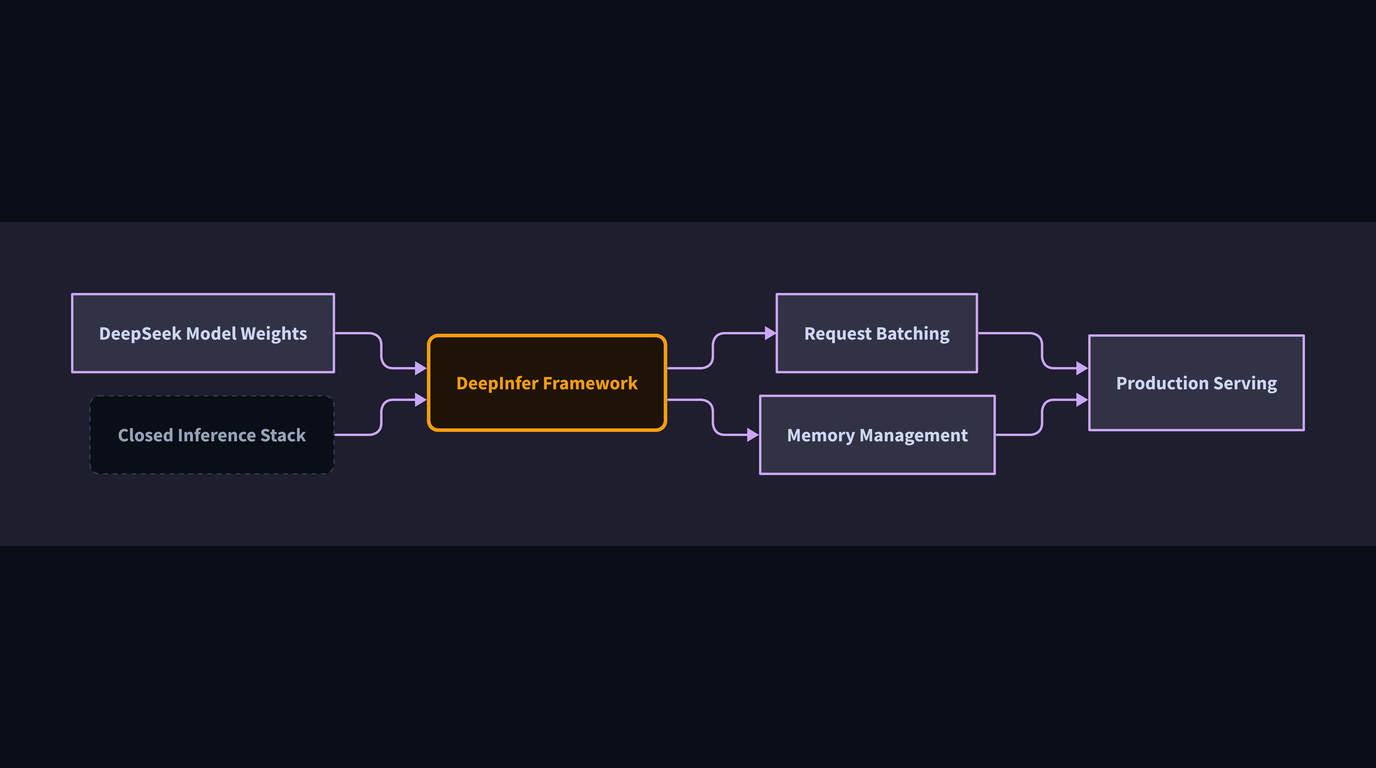
A framework built for inference is essentially the engine that sits between the raw model weights (the numerical values the model learned during training) and the real-world requests coming in. It handles batching (grouping multiple requests together so the hardware is not sitting idle between single calls), memory management, throughput optimization, and the low-level mechanics of keeping a large model running efficiently under load.
DeepSeek is releasing this as open source, meaning anyone can inspect it, use it, and build on it without a licensing fee.
Why it matters
The model is only half the equation. How you run it at production scale is the other half, and that second half is where most real operational costs live.
Consider a real estate company that has built an internal AI assistant for agents, or a SaaS platform that has embedded AI into its product for thousands of concurrent users. The model quality matters, but so does how efficiently that model serves requests when ten, a hundred, or ten thousand people are hitting it at the same time. A slow, memory-inefficient inference setup raises cost and degrades user experience regardless of how capable the underlying model is.
When a lab releases its inference framework alongside its models, it is giving operators and developers the tools to run those models the way the lab itself intended. That closes a gap that has historically caused real problems. Operators would take a capable model, run it through a generic serving setup, and end up with performance well below what the model could actually deliver, because the tooling was not matched to the architecture.
Open-sourcing the inference layer also means the community can audit it, improve it, and adapt it for specific deployment environments. That matters for organizations in regulated industries like healthcare or financial services, where sending data to an external API (a connection point where your system sends a request and receives a response back from a model hosted elsewhere) is not always an option, and running models on controlled infrastructure is a requirement.
What most people get wrong
The common mistake is treating a release like this as a developer story and nothing more. Operators hear “open-source inference framework” and assume it only concerns engineers.
It concerns anyone making a build-versus-buy decision on AI. If you are evaluating whether to call an external API or run a model closer to your own systems, the quality of the available inference tooling is a real input into that decision. Poor tooling raises the engineering cost of self-hosted or private deployments. Good tooling lowers it.
DeepSeek has been notable for releasing capable models at a cost structure that surprised a lot of the industry. An inference framework purpose-built for those models extends that same logic. The models become more accessible to operators who want to run them well, not just run them.
The other mistake is assuming open source means unsupported or rough around the edges. Purpose-built inference frameworks from the labs that trained the models tend to reflect a deep understanding of where those models are architecturally unusual. DeepSeek’s model designs have included notable efficiency choices. An inference framework from the same team is likely built with those choices in mind in ways that generic alternatives are not.
The short version
Models get the attention. Infrastructure is where the operational work actually happens. When a lab open-sources the layer that sits between its model and production traffic, that is a meaningful signal about accessibility and deployability, not just a GitHub announcement.
If your team is evaluating AI deployment options or trying to understand what running a capable model actually requires, the infrastructure conversation is the one worth having first.
More on that kind of thinking at xovionlabs.com.
The Signal
Read next.
AI · Local AI
Dirt-Cheap GPUs Are Coming. Here Is What That Actually Means for Operators.
Reports are surfacing that significantly cheaper GPUs could hit the market next year. Here is what operators need to understand about what lower hardware costs actually change, and what they do not.
AI · Local AI
NVIDIA Just Released a 74-Billion-Parameter Model That Runs Like a Much Smaller One
NVIDIA's Nemotron Bolt 3.5 74B A9B is a large language model designed to run efficiently on hardware that would normally struggle with a model this size. Here is what operators need to understand about what that actually means.