The Signal
AI
When ChatGPT Says No: What Content Refusals Actually Mean for Operators
A Reddit post about ChatGPT refusing to generate a meme is a small window into something operators deal with constantly: AI content policies and where they draw lines. Here is what that actually means for anyone building AI into a workflow.
The Signal #126 — Dakota’s read on the AI news that actually matters to people running a business.
You ask the AI to do something simple. It says no.
That moment is frustrating when it happens to you personally. It becomes a real operational problem when it happens inside a workflow your team or your customers depend on.
A recent post on the ChatGPT subreddit captured this exactly. A user shared that ChatGPT rejected their meme, apparently finding something in the content that triggered a refusal. The post resonated. It climbed the subreddit, collected comments, and surfaced a conversation that operators building on AI tools should pay close attention to.
What happened
A user on Reddit posted that ChatGPT refused to generate a meme they requested. The post gained traction in the ChatGPT community, with other users sharing similar experiences and debating where the model’s content policies are drawing lines. The specific content of the rejected meme is not the point. The pattern is.
ChatGPT, like every major commercial AI model, runs content filtering systems alongside its core language capability. These systems are designed to catch outputs the provider considers harmful, legally risky, or violating their usage policies. They operate on a spectrum. Some refusals are obvious and warranted. Others, as users frequently report, feel inconsistent or overly cautious, blocking requests that seem clearly benign.
The Reddit thread is one example of a much broader, ongoing conversation happening across every platform where AI is used at scale.
Why it matters
If you are using an AI tool personally, a refusal is annoying. If you are using an AI tool inside a product, a customer-facing workflow, or an automated process, a refusal is an incident.
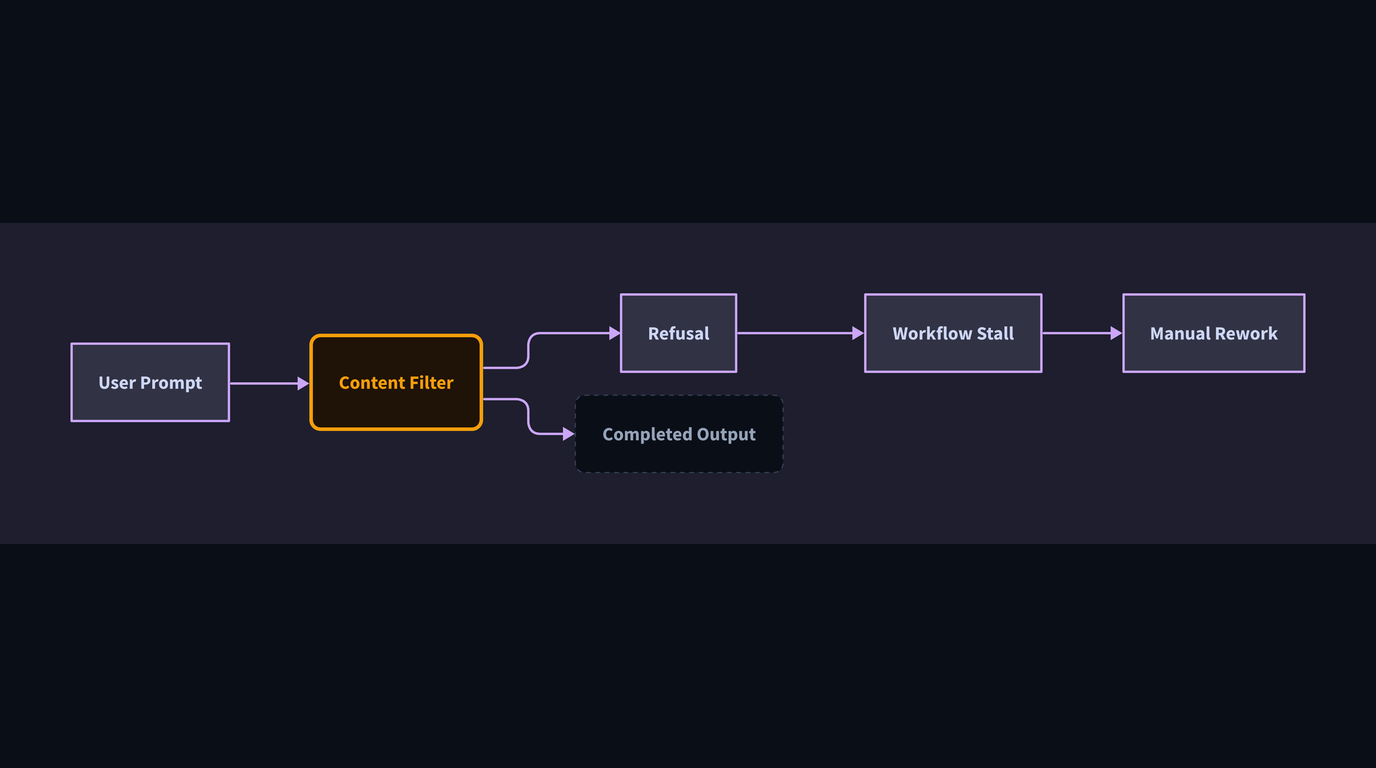
Think about an e-commerce brand using AI to generate product descriptions. The model flags something in a description for a product category it considers sensitive, like supplements, certain apparel, or anything adjacent to health claims. The output stops. The pipeline stalls. Someone has to intervene.
Or think about a real estate agency using AI to draft listing copy. A prompt includes language the model interprets as potentially discriminatory under fair housing rules, even if the intent was entirely neutral. Refusal. Delay. Manual rework.
The refusal itself is not always wrong. Sometimes the filter caught something worth catching. But the problem for operators is that these systems are not fully transparent. You often do not know exactly why a refusal happened, which makes it hard to adjust your prompt, your process, or your expectations in a systematic way.
Content policies also shift. A model that handles a certain type of request today may handle it differently after the next update. That is not a criticism, it is just the operational reality of building on a system you do not control.
What most people get wrong
Most people treat a refusal as a one-time nuisance and move on. The workaround works, the task gets done, and nobody documents what happened.
That is a gap. If you are relying on an AI tool in any repeatable workflow, refusals are signal worth tracking. A single refusal might be noise. A pattern of refusals in a specific part of your process is telling you something about the gap between what you need the tool to do and what the tool is actually designed to do.
There is also a category error that shows up constantly. People assume that if an AI is capable of a task, it will perform that task on demand. Capability and permission are two different things in commercial AI systems. A model may be fully capable of generating the content you want. The content policy layer sits on top of that capability and can override it regardless.
This distinction matters most when you are evaluating an AI tool for a workflow. The right question is not just, can this model do what I need? It is, will this model do what I need, consistently, in the context of my actual use case, within the content policies this provider applies?
Those are different questions. Only the second one tells you whether the tool is reliable for your operation.
The lesson
Refusals are not bugs. They are features, sometimes helpful, sometimes poorly calibrated, always worth understanding. When you are building AI into anything that runs repeatedly or touches customers, test for refusals deliberately. Probe the edges of your use case before you deploy, not after.
If a tool’s content policies are regularly blocking legitimate work in your context, that is not a problem you should try to route around indefinitely. It is a signal that the tool may not be the right fit, or that your prompting approach needs a structural rethink.
If you are sorting through what AI tools actually fit your operation, and what their real limitations look like in practice, start at xovionlabs.com.
The Signal
Read next.
AI · Trust
When AI Refuses to Answer, That Is an Answer Too
A viral X post is asking people to test every major AI chatbot with a politically charged question and compare the results. Here is what that experiment actually reveals for operators who depend on AI to give them straight answers.
AI · AI Governance
Goldman Sachs Just Pulled AI Coding Tools From Its Traders and Bankers. Here Is What That Decision Actually Tells Operators.
Goldman Sachs restricted Anthropic's Claude Code and Microsoft's GitHub to engineers only, cutting off traders and bankers who had been building their own tools. Here is what the reasoning behind that call means for any operator thinking about who gets access to AI agents.